
In today’s environment, one question dominates serious investors:
How do I generate consistent passive income without relying on volatile markets or low-yield savings?
In Malaysia, a growing number of investors are turning to P2P investing (peer-to-peer investing) as a powerful solution.
With average net returns around 8 - 15% per annum (disclaimer:capital at risk), P2P investing offers a powerful combination:
Consistent income potential + short investment cycles + scalable portfolio growth
But here’s what separates successful investors from the rest:
Passive income is not accidental, it’s engineered through strategy.
This guide shows you exactly how to build it.
Why P2P Investing Is Gaining Momentum in Malaysia
Compared to traditional options:
- Fixed deposits → 2–4% returns
- Stocks → High volatility
- Real estate → High capital requirements
P2P investing sits in a powerful sweet spot:
- Higher yields than banks
- Lower entry barriers than property
- More predictable cash flow than equities
Additionally, P2P platforms in Malaysia are regulated by the Securities Commission Malaysia (SC), providing structure, transparency, and investor protection
Step 1: Define Your Passive Income Target
Clarity drives results.
Ask yourself:
- How much monthly income do I want?
- How much capital can I allocate?
- What level of risk am I comfortable with?
Example:
If your goal is:
RM 2,000/month (RM 24,000/year)
At a 10% net return (assumption), you need:
~RM 240,000 invested
This turns your goal into a clear, actionable roadmap.
Step 2: Diversify Your Portfolio (Golden Rule)
If there is one rule in P2P investing, it is this:
Never overexpose yourself to a single issuer
Recommended structure:
- Allocate only 2%–5% per investment note and issuer
- Spread capital across 20–50+ SMEs
Example:
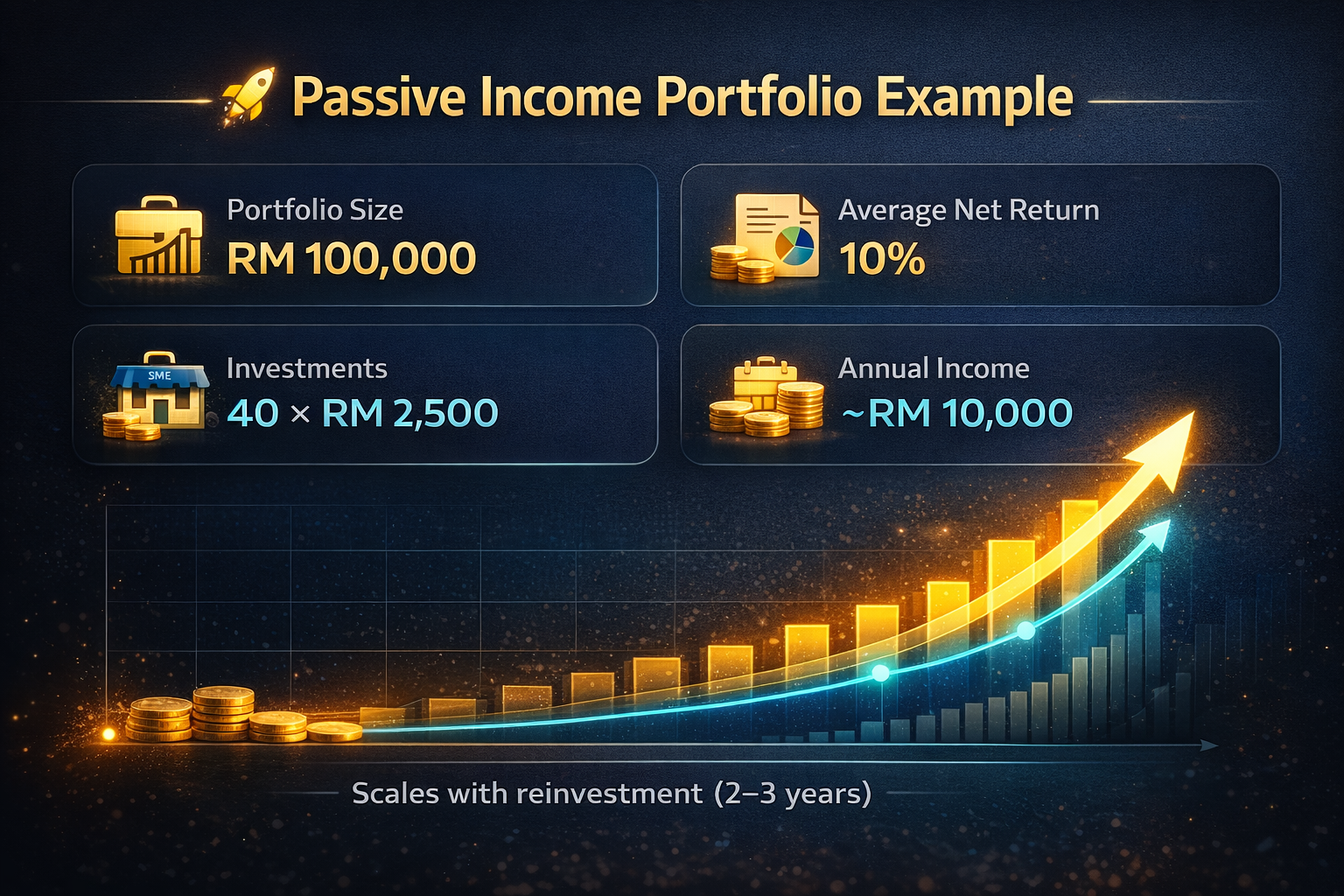
With RM 100,000:
- RM 2,000–RM 5,000 per deal
- 20–50 diversified investments
Disclaimer: There is a risk of no return and loss of the invested capital.
Why this works:
- Reduces default impact
- Stabilizes income
- Improves long-term consistency
Step 3: Balance Risk and Return
A strong portfolio blends multiple risk tiers.
Suggested allocation:
| Risk Tier | Net Return Range | Allocation |
|---|---|---|
| Lower Risk (A/B) | 7%–9% | 40% |
| Medium Risk (B/C) | 9%–11% | 40% |
| Higher Risk (C+) | 11%–13% | 20% |
Target outcome:
~10% blended net return with controlled risk
Step 4: Reinvest to Unlock Compounding
The biggest mistake investors make:
Withdrawing returns too early
Instead:
Reinvest all repayments and returns
The result:
- Faster portfolio growth
- Compounding returns
- Accelerated income scaling
Over time, your portfolio becomes a self-reinforcing income engine.
Step 5: Focus on Investment Quality
Not every opportunity deserves your capital.
Look for:
- Strong and consistent cash flow
- Clear use of funds (e.g., working capital, invoice financing)
- Healthy financial metrics
- Credible management and guarantors
Top investors are highly selective.
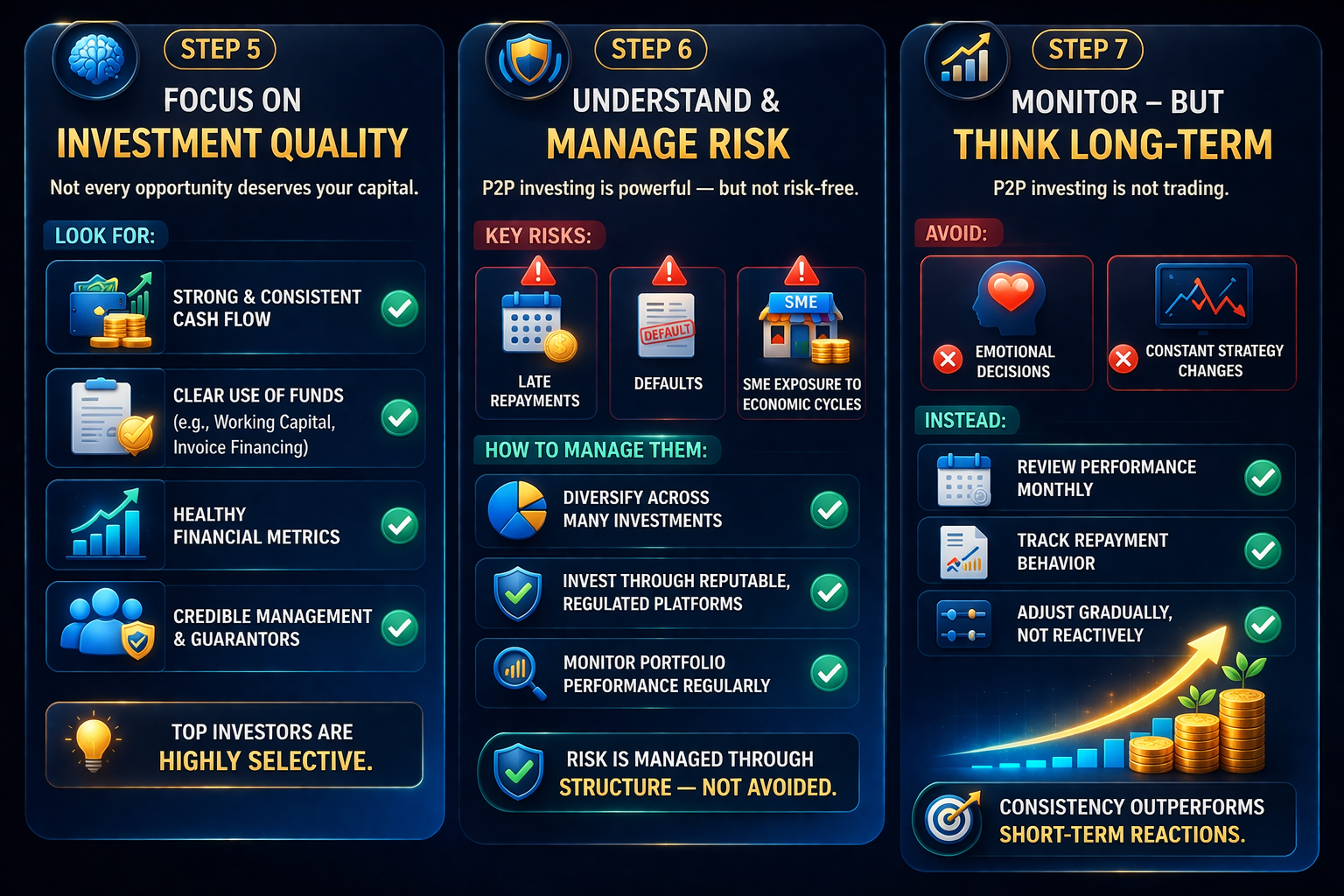
Step 6: Understand and Manage Risk
P2P investing is powerful but not risk-free.
Key risks:
- Late repayments
- Defaults
- SME exposure to economic cycles
How to manage them:
- Diversify across many investments
- Invest through reputable, regulated platforms
- Monitor portfolio performance regularly
Risk is managed through structure, not avoided.
Step 7: Monitor — But Think Long-Term
P2P investing is not trading.
Avoid:
Emotional decisions
Constant strategy changes
Instead:
- Review performance monthly
- Track repayment behavior
- Adjust gradually
Consistency outperforms short-term reactions.
Example: Passive Income Portfolio in Action
Portfolio Size: RM 100,000
Investments: 40 × RM 2,500
Average Net Return: 10%
Annual Income: ~RM 10,000
Monthly Income: ~RM 830
With reinvestment:
This can scale meaningfully within 2–3 years
Why More Malaysian Investors Are Shifting to P2P Investing
The shift is clear:
- Demand for stable income
- Low-yield traditional instruments
- Growth of alternative investments
P2P investing is becoming a core building block of modern portfolios
Final Insight: Passive Income Is Built — Not Found
Top investors don’t chase returns. They build systems.
With:
- Diversification
- Discipline
- Long-term thinking
Passive income becomes predictable, scalable, and sustainable.
Key Takeaway
P2P investing in Malaysia can deliver up to ~10% net annual returns (note: there is a risk of loss of capital) and is one of the most effective ways to build a scalable passive income portfolio, when executed with discipline.
Important Disclaimer: T&C apply. Investments in P2P and ECF campaigns may lead to the loss of the entire capital invested. Do not invest more than you can afford to lose. This is not an offer or solicitation to make any type of investments. This article has not been reviewed by the Securities Commission Malaysia.